
Prime factorisation
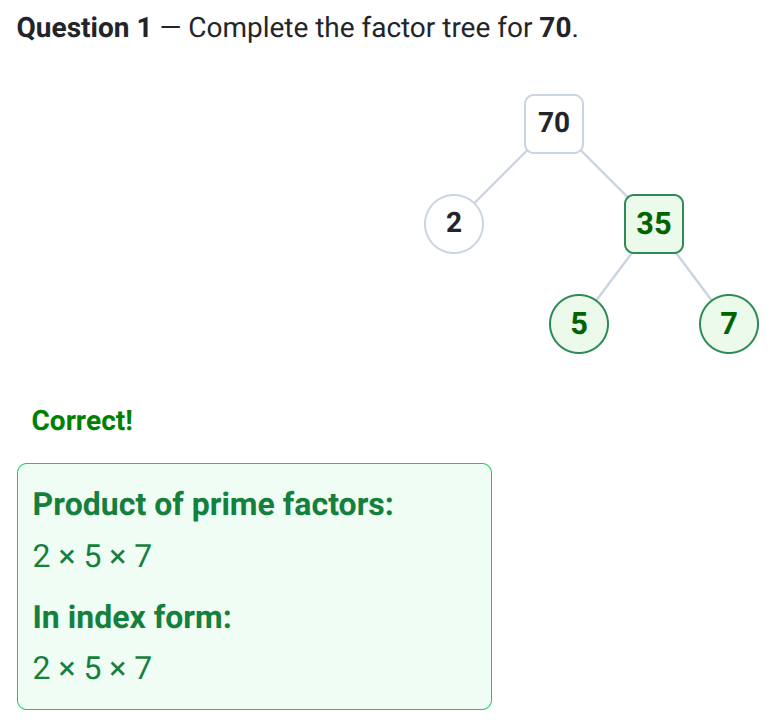
Prime factorisation means breaking a composite number down until every final factor is prime. Complete each factor tree by continuing to split the numbers in quadrilaterals and circling the prime numbers at the ends of the branches. Jump to the questions
Practise now
Worksheet preview and key skills
Worksheet preview
This worksheet helps you write numbers as a product of their prime factors. You will complete increasingly challenging factor trees to break composite numbers down into prime numbers.
You will use visual cues—quadrilaterals for composite numbers and circles for prime numbers—to check that each pair of branches multiplies to its parent. When a tree is complete, the prime product and index form are shown automatically.
What you’ll practise
- Completing six progressively harder factor trees
- Continuing to split composite numbers inside quadrilaterals
- Identifying when a branch stops at a prime number inside a circle
- Checking that each pair of branches multiplies to its parent
- Seeing the completed prime product and index form after a correct answer
Use the interactive worksheet below, or read the Topic guide for the method and worked example.
Prime factorisation
Complete each factor tree. Circles contain prime numbers and quadrilaterals contain numbers that must be split again. When your tree is correct, its prime factors will be shown below it.
Topic guide
What prime factorisation means
A prime number has exactly two positive factors: 1 and itself. The first few prime numbers are 2, 3, 5, 7, 11, 13, 17, and 19. A composite number has more than two factors.
Prime factorisation is the process of writing a composite number as a product (multiplication) of prime numbers.
Reading the shapes
When completing a factor tree on this worksheet, the shapes tell you what to do next:
- Quadrilateral: A composite number that still needs splitting.
- Circle: A prime number where that branch stops.
In a handwritten factor tree, it is very common practice to draw a circle around each prime number you find so you don't lose it.
Completing a factor tree
A factor tree helps you break a number down step by step:
- Start with your number at the top and split it into a valid factor pair (two numbers that multiply to make it).
- Check that the two children multiply to their parent.
- Continue splitting every composite number (inside quadrilaterals).
- Circle each prime number.
- Stop only when every branch ends in a circled prime number.
Worked example
Let's find the prime factorisation of 84 using a factor tree. We start with 84 in a quadrilateral.
First, we split 84 into a factor pair, like 12 and 7.
- 7 is a prime number, so we put it in a circle and stop on that branch.
- 12 is composite, so we put it in a quadrilateral.
Next, we split the 12 in the quadrilateral into 3 and 4.
- 3 is prime, so we put it in a circle.
- 4 is composite, so we put it in a quadrilateral.
Finally, we split the 4 in the quadrilateral into 2 and 2.
- Both 2s are prime, so we put them in circles and we are finished.
Even if you had started with a different pair for 84 (like 6 and 14), you would still finish with the exact same collection of prime numbers.
Converting the tree into index form
Once every branch ends in a prime circle, we can collect all those prime numbers and write them as a multiplication:
84 = 2 × 2 × 3 × 7
If a prime number appears more than once, we collect the repeated copies using index notation (powers) to give our final answer:
84 = 2² × 3 × 7
Common mistakes
- Circling a composite number.
- Continuing to split a prime number.
- Using children that do not multiply to the parent.
- Forgetting one prime leaf when collecting the final answer.
- Treating 1 as prime (1 is not prime and should not be used in factor trees).
- Stopping before every branch ends in a circle.