
Pythagoras on a Coordinate Grid
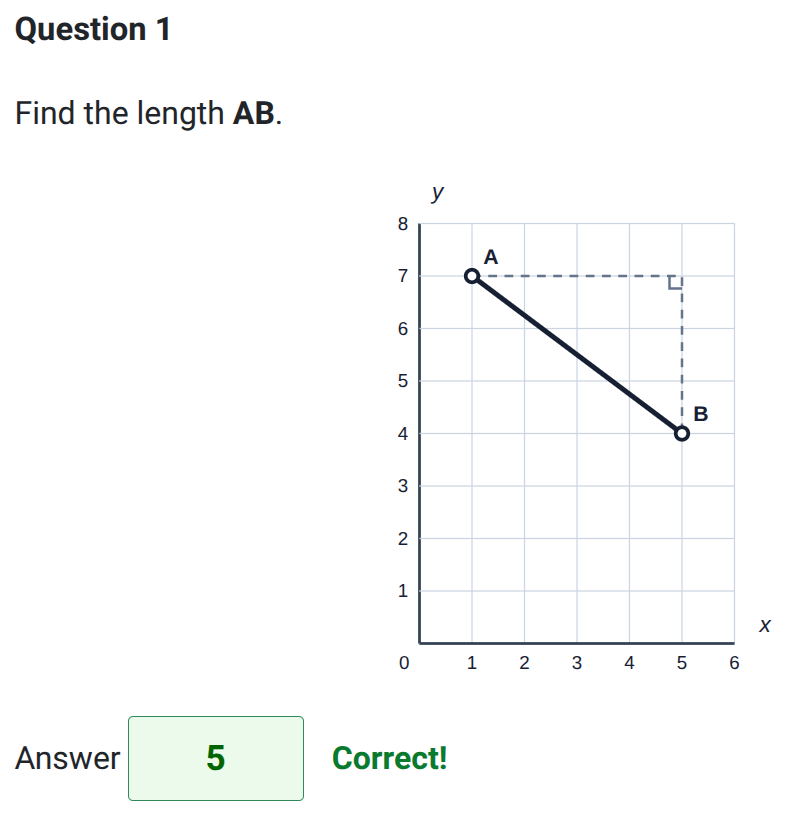
Use Pythagoras to find straight-line distances between points on a coordinate grid. This GCSE worksheet builds from plotted first-quadrant segments to negative and decimal coordinates, triangle perimeters and a reverse problem with two possible answers.
Work through the questions, or review the Topic guide for the right-triangle method and worked examples. Jump to the questions
Practise now
Worksheet preview and key skills
Worksheet preview
Find straight-line distances by turning horizontal and vertical coordinate changes into the perpendicular sides of a right-angled triangle.
Eight self-marking questions progress from scaffolded diagrams to calculations from coordinates, perimeter and a reverse-coordinate challenge.
What you’ll practise
- Reading horizontal and vertical changes across positive and negative axes
- Using Pythagoras and rounding non-integer distances to 1 decimal place
- Finding a triangle perimeter and both possible values of an unknown coordinate
Use the interactive worksheet below, or read the Topic guide for the method and worked examples.
Pythagoras on a Coordinate Grid
Use the horizontal and vertical changes to form a right-angled triangle, then apply Pythagoras. Give decimal answers to 1 decimal place where requested.
Name: ________________________________________
Topic guide
Distance as a right-angled triangle
To find the straight-line distance between two points, imagine drawing a horizontal line and a vertical line to make a right-angled triangle. The horizontal change and vertical change are its two shorter sides. The line joining the original points is the hypotenuse.
- Find the horizontal change: |x₂ − x₁|.
- Find the vertical change: |y₂ − y₁|.
- Use a² + b² = c², then take the positive square root.
- Round only at the end if the question asks for a decimal answer.
Worked example: crossing the axes
Find the distance from P = (−3, 4) to Q = (5, −2).
The horizontal change is |5 − (−3)| = 8. The vertical change is |−2 − 4| = 6. Notice that crossing zero makes the change larger; it does not make the distance negative.
Therefore PQ² = 8² + 6² = 64 + 36 = 100, so PQ = √100 = 10 units.
Counting 8 squares across and then 6 squares down would give 14, but that is a route along two sides. The straight-line distance is the hypotenuse, so it is 10.
Non-integer distances and rounding
If the squared length is not a square number, keep the square root on your calculator until the final step. For example, horizontal and vertical changes of 5 and 4 give √(5² + 4²) = √41 = 6.403…, which is 6.4 to 1 decimal place.
Reverse coordinates: why there can be two answers
Suppose A = (2, 3), B = (8, p) and AB = 10. The horizontal change is 6, so the vertical change satisfies 6² + (p − 3)² = 10². This gives (p − 3)² = 64, so p − 3 = 8 or p − 3 = −8. Therefore p = 11 or p = −5.
The two answers place B the same vertical distance above or below A. In compact form, the distance formula is √((x₂ − x₁)² + (y₂ − y₁)²), but it represents exactly the same right triangle.
Common mistakes
- Do not add the horizontal and vertical changes: that counts a route around the triangle.
- Use brackets when subtracting a negative coordinate.
- Distances are never negative, even when coordinates are negative.
- For a perimeter, calculate all three side lengths before adding them.
- In a reverse problem, remember both the positive and negative square roots.