
Ratios in the form of n to 1
Ratios help us compare quantities, and simplifying them in the form of n:1 makes it easier to understand relationships. For example, if a map scale is 8 cm to 2 km, simplifying to 4:1 shows that every 4 cm on the map represents 1 km in real life. This method is useful in engineering, architecture, and scaling models accurately! Jump to the questions
Practise now
Worksheet preview and key skills
Worksheet preview
Practise ratios in the form of n to 1 with this self-marking maths worksheet.
The interactive worksheet below generates questions, gives instant feedback, and lets students record their score.
What you’ll practise
- Dividing both parts of the ratio by the second part.
- Making the second part equal to 1.
- Writing the first part as a number or decimal.
- Keeping the ratio in equivalent form.
Use the interactive worksheet below, or read the Topic guide for the method and worked example.
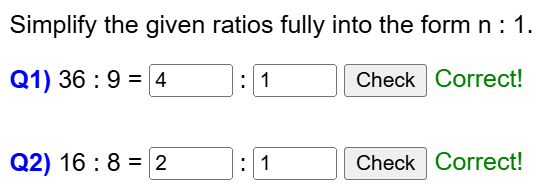
Simplify the given ratios fully into the form n : 1.
Topic guide
What this worksheet practises
This worksheet provides practice on converting ratios into the specific format "n : 1". This means the right-hand side of the ratio must be exactly the number 1, and the left-hand side ('n') will be the resulting value, often a decimal or fraction. This is used frequently to calculate "unit costs" (how much you get for £1).
Key method
You must force the right-hand number to become a 1.
- Look at the number on the right side of the original ratio.
- Divide both sides of the entire ratio by this exact number.
- The right side will automatically become 1.
- Calculate the new value for the left side. Do not worry if it is a decimal.
Worked example
1) Write the ratio 18 : 6 in the form n : 1.
2) Write the ratio 7 : 5 in the form n : 1.
Example 1: (18 : 6)
Step 1: The right number is 6. We must divide both sides by 6.
Right side: 6 ÷ 6 = 1.
Left side: 18 ÷ 6 = 3.
Final Answer: 3 : 1. (Here, n = 3).
Example 2: (7 : 5)
Step 1: The right number is 5. We must divide both sides by 5.
Right side: 5 ÷ 5 = 1.
Left side: 7 ÷ 5 = 1.4. (You can use a calculator or write it as 7/5).
Final Answer: 1.4 : 1. (Here, n = 1.4).
Common mistakes to avoid
A very common error is mixing up the format. A student asked to find "n : 1" will often calculate "1 : n" instead. Always pay close attention to the position of the '1' in the question. If the 1 is on the right, you must divide by the number on the right.
How to check your answer
If the original ratio is "top-heavy" (the left number is bigger, like 18:6), your 'n' value will always be greater than 1. If the original ratio is "bottom-heavy" (the left number is smaller, like 2:8), your 'n' value will always be a decimal starting with "0.".