
Capture recapture
Estimating total populations using the **capture-recapture** method is a clever technique used in ecology, conservation, and even human studies. It works by capturing a sample of a population, marking them, and then releasing them back. After some time, another sample is taken, and the proportion of marked individuals helps estimate the total population size. This method is used to track wildlife numbers, monitor endangered species, and even estimate human populations in hard-to-reach areas like homeless communities. Jump to the questions
Practise now
Worksheet preview and key skills
Worksheet preview
Practise capture-recapture with this self-marking maths worksheet.
The interactive worksheet below generates questions, gives instant feedback, and lets students record their score.
What you’ll practise
- Using the first capture, second capture and recapture numbers.
- Setting up a proportion to estimate population size.
- Multiplying and dividing accurately.
- Understanding that the answer is an estimate.
Use the interactive worksheet below, or read the Topic guide for the method and worked example.
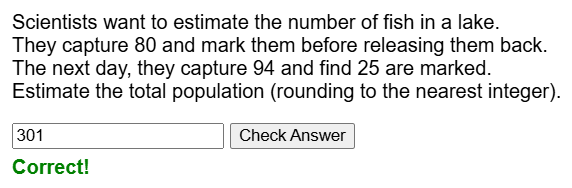
Estimate the total population using the capture-recapture method.
Topic guide
What this worksheet practises
This worksheet explores the capture-recapture method. This is a statistical technique used to estimate the total size of a population in the wild, such as the number of fish in a lake or birds in a forest, without having to count every single one.
Key method
The capture-recapture formula relies on the assumption that the proportion of marked animals in a second sample is the same as the proportion of marked animals in the whole population. The equation is:
Total Population (N) = (Number originally marked × Total size of second sample) ÷ Number marked in the second sample
Worked example
A researcher catches 40 fish, tags them, and releases them. Later, they catch 50 fish and find that 10 of them have tags. Estimate the total number of fish in the lake.
Step 1: Identify your values.
- Number originally marked = 40
- Total size of second sample = 50
- Number marked in second sample = 10
Step 2: Multiply the originally marked amount by the total second sample size.
40 × 50 = 2000
Step 3: Divide that result by the number of marked animals in the second sample.
2000 ÷ 10 = 200
The estimated total population is 200 fish.
Useful tips
Think about the real-world conditions needed for this method to work. It assumes that marks are not lost, that marked and unmarked animals mix thoroughly, and that the population doesn't change significantly (through births, deaths, or migration) between the two samples.
Common mistakes to avoid
Be careful not to mix up the numbers from the second sample. The denominator is always the marked ones from the second sample, not the whole second sample.