
Stratified sampling
Stratified sampling is a method used in statistics to ensure that different groups within a population are properly represented in a sample. Imagine surveying students about their favorite subjects—if your school has 60% boys and 40% girls, a stratified sample would keep that same ratio, giving you more accurate results than a completely random selection. This technique is especially useful in research to avoid bias and make fair comparisons between different groups. Jump to the questions
Practise now
Worksheet preview and key skills
Worksheet preview
Practise stratified sampling with this self-marking maths worksheet.
The interactive worksheet below generates questions, gives instant feedback, and lets students record their score.
What you’ll practise
- Using group sizes from a population.
- Calculating proportional sample sizes.
- Choosing a sample that reflects the population structure.
- Rounding sample sizes where needed.
Use the interactive worksheet below, or read the Topic guide for the method and worked example.
Topic guide
What this worksheet practises
This worksheet focuses on stratified sampling. When a population is split into different groups (like Year 7, Year 8, Year 9), a random sample isn't always fair if some groups are much bigger than others. A stratified sample ensures that the number of people chosen from each group is exactly proportional to the group's size.
Key method
It is essentially a fraction calculation applied to a total.
- Identify the Total Population (everyone in all groups combined).
- Identify the size of the Specific Group you are focusing on.
- Identify the Sample Size (how many people you want to pick in total).
- Use the formula: (Group Size ÷ Total Population) × Sample Size.
- Because you cannot sample half a person, you may need to round your final answer to the nearest whole number.
Worked example
A school has 400 students in total. There are 150 students in Year 7. The headteacher wants to take a stratified sample of 60 students for a survey. How many Year 7 students should be in the sample?
Step 1: Write down the three key numbers.
Total Population = 400. Group Size = 150. Sample Size = 60.
Step 2: Put them into the formula.
(150 ÷ 400) × 60.
Step 3: Calculate the fraction first (this tells you what proportion of the school is in Y7).
150 ÷ 400 = 0.375.
Step 4: Multiply this proportion by the sample size.
0.375 × 60 = 22.5.
Step 5: Round to the nearest whole number.
The sample should contain 23 Year 7 students.
Common mistakes to avoid
A common error is mixing up the Sample Size and the Total Population in the formula. If you accidentally calculate (150 ÷ 60) × 400, you will get an answer of 1000 people. Always sense-check your answer: if you are only taking a sample of 60 people in total, your answer for a single group must be smaller than 60.
Things to remember
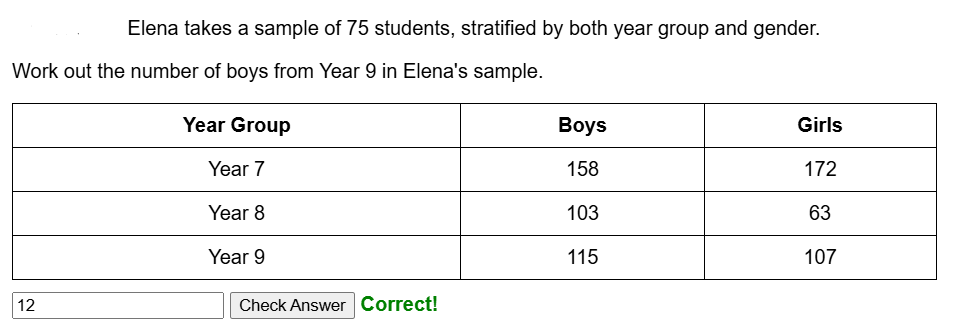
Sometimes the question will give you a table of different groups but will not explicitly tell you the Total Population. In this case, your very first step must be adding all the groups together to find the Total Population yourself before you can use the formula.