
Reflections
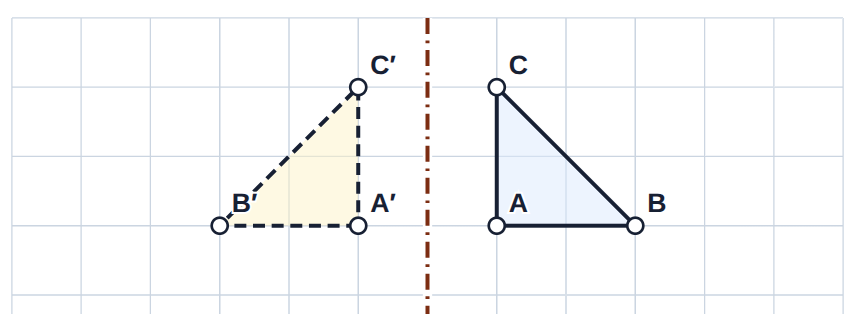
Practise Foundation GCSE reflections by drawing mirror images of shapes on square and coordinate grids. Reflect in the axes and in horizontal and vertical lines, describe a reflection using its mirror line, then try a final challenge with y = x. Jump to the questions
Practise now
Worksheet preview and key skills
Worksheet preview
Eight questions progress from vertical and horizontal mirror lines on plain grids to reflections in the axes, x = a and y = a. The final drawing challenge uses y = x.
Place every labelled image vertex in seven drawing questions. In Question 7, type a full description of the reflection taking shape A onto shape B.
What you’ll practise
- Keeping corresponding vertices the same perpendicular distance from the mirror line.
- Reflecting a whole polygon, including a vertex that stays on the mirror line.
- Identifying a reflection and stating its mirror line.
Use the interactive worksheet below, or read the Topic guide for the method and worked example.
Reflections
Place each reflected vertex in the labelled order, then check your answer. For Question 7, type the transformation and its mirror line.
Topic guide
What is a reflection?
A reflection flips a shape in a mirror line. The original and its image are congruent: they have the same shape and size. Each vertex and its image are the same perpendicular distance from the mirror line, on opposite sides. A vertex on the mirror line stays fixed.
Reflecting a whole shape
Find the mirror line first. For each vertex, count squares straight towards the line, then continue the same distance on the other side. Count horizontally for a vertical mirror line and vertically for a horizontal mirror line. Join the image vertices in the same order as the original.
On this worksheet, tap the image of A first, then B and the remaining vertices. The buttons show which image vertex you are placing. Select a vertex button to replace a point, or use Clear drawing to start again. Every corresponding vertex must be correct.
Axes and other mirror lines
The y-axis is the vertical line x = 0; the x-axis is the horizontal line y = 0. A line such as x = 2 is vertical and passes through 2 on the x-axis. A line such as y = −1 is horizontal and passes through −1 on the y-axis.
Worked example: reflecting in x = 1
A triangle has vertices A(−3, 1), B(−1, 1) and C(−2, 3). Reflect it in x = 1.
A is 4 squares left of the mirror line, so A′ is 4 squares right of it, at (5, 1). B is 2 squares left, giving B′(3, 1). C is 3 squares left, giving C′(4, 3). The y-coordinates stay the same. Join A′, B′ and C′ to complete the triangle.
Describing a reflection
Compare corresponding vertices on the two shapes. Their midpoints lie on the mirror line, and the segments joining each pair cross it at right angles. Check more than one pair. State both the transformation and the line, for example “reflection in the line y = 2”. A line equation alone is not a full description.
Challenge: reflecting in y = x
The line y = x runs diagonally through points such as (−2, −2), (0, 0) and (3, 3). Reflection in this line swaps the coordinates: (1, 4) reflects to (4, 1). Apply this to every vertex, then join the image points in order.
Common mistakes
- Count grid intervals, not grid lines, and use perpendicular distances.
- Do not slide the shape: a reflection reverses its orientation.
- A point on the mirror line stays where it is. An original and its reflected image can touch or overlap.
- Keep each label with its matching image vertex, even if the outline looks right.
- Do not confuse the axes: reflection in the y-axis changes left and right; reflection in the x-axis changes up and down.