
Similar polygons and missing lengths
Similar triangles pop up everywhere — from architects designing buildings to artists creating perfect perspectives. By understanding similar triangles, you can figure out missing lengths without ever needing a ruler, just by using proportional reasoning! Jump to the questions
Practise now
Worksheet preview and key skills
Worksheet preview
Practise similar polygons and missing lengths with this self-marking maths worksheet.
The interactive worksheet below generates questions, gives instant feedback, and lets students record their score.
What you’ll practise
- Matching corresponding sides in similar polygons.
- Finding the scale factor.
- Multiplying or dividing by the scale factor.
- Using similarity to find missing lengths.
Use the interactive worksheet below, or read the Topic guide for the method and worked example.
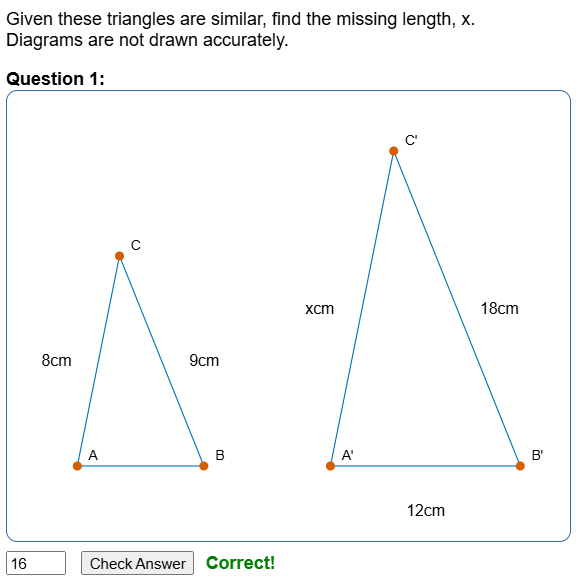
Given these triangles are similar, find the missing length, x.
Diagrams are not drawn accurately.
Topic guide
What this worksheet practises
This worksheet provides practice on using similarity to find missing lengths on complex polygons. This requires you to find the scale factor first, and then apply it to a different part of the shape.
Key method
Finding missing sides requires a two-step process.
- Step 1: Find the Scale Factor. Find a pair of corresponding sides where you know both lengths. Divide the Large Side by the Small Side (Large ÷ Small).
- Step 2: Find the Missing Side. Look at the side you want to find. Find its corresponding partner on the other shape.
- If you are looking for a side on the Large Shape: Multiply the small partner by the Scale Factor.
- If you are looking for a side on the Small Shape: Divide the large partner by the Scale Factor.
Worked example
Two similar triangles are given. The small triangle has a base of 5cm and a height of 'x'. The large triangle has a base of 15cm and a height of 12cm. Find the missing height 'x'.
Step 1: Find the matching pair to calculate the Scale Factor. We know both bases (5 and 15).
Scale Factor = Large ÷ Small = 15 ÷ 5 = 3.
Step 2: We want to find 'x', which is the height of the Small Shape. Its partner is the large height (12).
Because we want the small side, we divide the large partner by the scale factor.
x = 12 ÷ 3 = 4.
The missing height is 4cm.
Common mistakes to avoid
A frequent error is doing the correct division to find the scale factor, but then doing the wrong operation (multiplying instead of dividing, or vice versa) in step 2. Always ask yourself: "Am I trying to find a bigger line or a smaller line?". If it's a smaller line, you must divide.
Things to remember
Sometimes the scale factor will be a decimal or fraction (e.g., Large base = 15, Small base = 10, Scale Factor = 1.5). The method remains exactly the same. Do not round your scale factor if it is a messy decimal; use fractions instead to maintain perfect accuracy.