
Scale factor and similarity
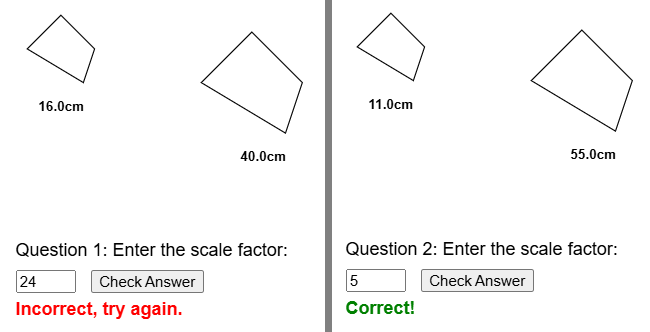
Similarity and Scale Factor often come up when resizing images, designing models, or even reading maps. Understanding how shapes stay the same while growing or shrinking helps us solve real-world problems like creating accurate blueprints or adjusting photos without distorting them. Jump to the questions
Practise now
Worksheet preview and key skills
Worksheet preview
Practise scale factor and similarity with this self-marking maths worksheet.
The interactive worksheet below generates questions, gives instant feedback, and lets students record their score.
What you’ll practise
- Identifying corresponding sides in similar shapes.
- Finding the scale factor from matching lengths.
- Enlarging or reducing lengths using the scale factor.
- Checking that matching sides use the same scale factor.
Use the interactive worksheet below, or read the Topic guide for the method and worked example.
Topic guide
What this worksheet practises
This worksheet focuses on finding the "scale factor" between two mathematically similar shapes. Similar shapes are exactly the same shape, just different sizes; one is a perfect, zoomed-in enlargement of the other.
Key method
To find a scale factor, you must compare two sides that correspond (match up) between the two shapes.
- Identify a side on the Small Shape whose length is known.
- Identify the exactly corresponding side on the Large Shape whose length is also known.
- Calculate the Scale Factor by dividing the Large Side by the Small Side: Scale Factor = Large ÷ Small.
- Once you have the Scale Factor, you can use it to find other missing sides. Multiply a small side by the scale factor to find a big side. Divide a big side by the scale factor to find a small side.
Worked example
Two similar rectangles are drawn. The small rectangle has a base of 3cm. The large rectangle has a base of 12cm. Find the scale factor of enlargement.
Step 1: Identify the matching sides. We have both bases: 3cm and 12cm.
Step 2: Divide the large side by the small side.
Scale Factor = 12 ÷ 3 = 4.
The scale factor is 4 (meaning the large shape is exactly 4 times bigger than the small shape).
Common mistakes to avoid
The most common mistake is mixing up which sides correspond. If the shapes have been rotated, students sometimes divide the base of the large shape by the height of the small shape. Always ensure you are comparing exactly the same edge on both shapes.
Things to remember
A scale factor is just a multiplier; it does not have any units (it is not 4cm, it is just 4). Also, while the side lengths are multiplied by the scale factor, the angles inside similar shapes remain exactly the same. Do not multiply the angles by the scale factor.