
Time difference calculations
Working out the time difference between two times is a key skill for everyday life — from figuring out how long a journey takes, to knowing how much time you have left before a deadline. It's all about keeping track of time accurately and planning ahead with confidence! Jump to the questions
Practise now
Worksheet preview and key skills
Worksheet preview
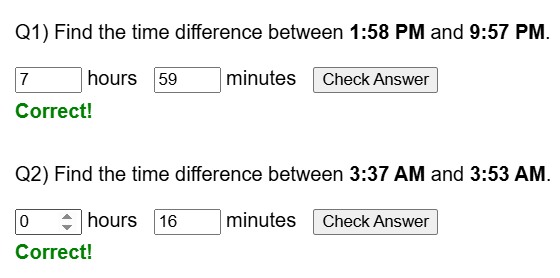
Practise time difference calculations with this self-marking maths worksheet.
The interactive worksheet below generates questions, gives instant feedback, and lets students record their score.
What you’ll practise
- Counting forwards or backwards between two times.
- Working across hours, days or midnight where needed.
- Converting between hours and minutes.
- Writing time differences using appropriate units.
Use the interactive worksheet below, or read the Topic guide for the method and worked example.
Topic guide
What this worksheet practises
This worksheet provides practice on calculating the exact difference between two times on a 12-hour or 24-hour clock. The most important thing to remember is that time operates in blocks of 60, not 100, so you cannot use normal column subtraction for difficult times.
Key method
The most foolproof method is the "Number Line" or "Stepping" method.
- Write down your Start Time on the left and your End Time on the right.
- Step 1 (Minutes to the hour): Jump from your Start Time to the very next "full hour". Note down how many minutes this took.
- Step 2 (The full hours): Jump from this new full hour across to the full hour closest to your End Time. Note down how many hours this took.
- Step 3 (The remaining minutes): Jump from this final full hour to your exact End Time. Note down the minutes.
- Add all your jumps together to get the total time difference.
Worked example
A train departs at 08:45 and arrives at 11:20. How long was the journey?
Start: 08:45. End: 11:20.
Step 1: Jump to the next full hour (09:00).
From 08:45 to 09:00 is 15 minutes.
Step 2: Jump the full hours to get close to the end (from 09:00 to 11:00).
From 09:00 to 11:00 is 2 hours.
Step 3: Jump the remaining minutes (from 11:00 to 11:20).
From 11:00 to 11:20 is 20 minutes.
Step 4: Add them all together.
2 hours + 15 mins + 20 mins = 2 hours and 35 minutes.
Common mistakes to avoid
The most catastrophic mistake is trying to use standard column subtraction on times. For example, 11:20 − 08:45. A student might try to "borrow" from the hours column, treating it like a normal 100s column, resulting in nonsensical answers. Never use column methods for time differences if the minutes cross over an hour boundary. Always use the stepping method.
Things to remember
If you have to do a calculation that crosses midnight (e.g. a flight from 22:30 to 04:15), the stepping method is even more vital. Jump from 22:30 to midnight first (1 hr 30 mins), and then jump from midnight to the end time (4 hr 15 mins), then add them together.