
Surface Area of a Sphere
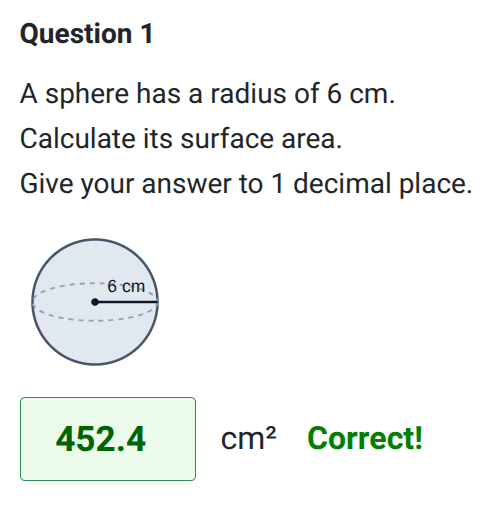
This worksheet practises using the formula 4πr² to find the surface area of a sphere.
You will need to recognise the difference between the radius and the diameter, and apply the method to solid hemispheres to find their total surface area. Jump to the questions
Practise now
Worksheet preview and key skills
Worksheet preview
This worksheet generates questions on finding the surface area of spheres and solid hemispheres.
The progression moves from straightforward substitution towards reverse problems and scaling factors.
What you’ll practise
- Calculating the surface area of a sphere given its radius or diameter.
- Finding exact answers in terms of π.
- Finding the total surface area of a solid hemisphere, including the circular base.
- Solving reverse problems to find the radius when the surface area is known.
- Understanding how changing the radius affects the surface area.
Use the interactive worksheet below, or read the Topic guide for the method and worked example.
Surface area of a sphere
Work out the surface area of the spheres and hemispheres. For total surface area of a solid hemisphere, remember to include the circular base.
Topic guide
The formula for the surface area of a sphere
To find the surface area of a sphere, you use the formula:
Surface area = 4πr²
where r is the radius of the sphere.
Radius and diameter
Always check whether you have been given the radius (from the centre to the edge) or the diameter (the full distance across through the centre).
If you are given the diameter, you must divide it by 2 to find the radius before using the formula.
Worked example: Sphere
Find the surface area of a sphere with a radius of 5 cm. Give your answer to 1 decimal place.
- Identify the radius: r = 5
- Substitute into the formula: Surface area = 4 × π × 5²
- Calculate 5² = 25
- Surface area = 4 × π × 25 = 100π
- Calculate the decimal: 100 × π ≈ 314.159...
- Round to 1 decimal place: 314.2 cm²
Total surface area of a solid hemisphere
A hemisphere is exactly half of a sphere. However, a solid hemisphere has two parts to its surface:
- The curved surface (half of a full sphere): 2πr²
- The flat circular base: πr²
To find the total surface area, you must add these together:
Total surface area = 3πr²
Reverse problems
If you are given the surface area and need to find the radius, you set up an equation and solve it.
The surface area of a sphere is 196π cm². Find its radius.
- Write the equation: 4πr² = 196π
- Divide both sides by π: 4r² = 196
- Divide by 4: r² = 49
- Square root: r = 7 cm
Scaling
Because the formula uses r², changing the radius has a squared effect on the surface area.
If you double the radius, the surface area increases by a factor of 2² = 4.
If you triple the radius, the surface area increases by a factor of 3² = 9.
Common mistakes
- Using the diameter instead of the radius: Always halve the diameter first.
- Using the volume formula: Surface area is 4πr², volume is 4/3 πr³.
- Forgetting to square the radius: You must calculate r², not just 2r.
- Wrong units: Surface area is an area, so it uses square units (e.g. cm², m²), not cubic units.
- Forgetting the circular base of a hemisphere: Remember to use 3πr² for the total surface area of a solid hemisphere.
- Rounding too early: Keep the full value of π or numbers on your calculator until the final step.