
Volume of a Sphere
This worksheet practises using the formula 4/3 πr³ to find the volume of a sphere.
You will need to recognise the difference between the radius and the diameter, find the volume of hemispheres, and work backwards from a given volume to find the radius. Jump to the questions
Practise now
Worksheet preview and key skills
Worksheet preview
This worksheet generates questions on finding the volume of spheres and hemispheres.
The progression moves from straightforward substitution towards finding the radius from a given volume, and finishes with an applied problem.
What you’ll practise
- Calculating the volume of a sphere given its radius or diameter.
- Finding exact volumes in terms of π.
- Finding the volume of a hemisphere.
- Working backwards to find the radius when the volume is known.
- Equating the volume of a sphere to another shape to solve a problem.
Use the interactive worksheet below, or read the Topic guide for the method and worked example.
Volume of a sphere
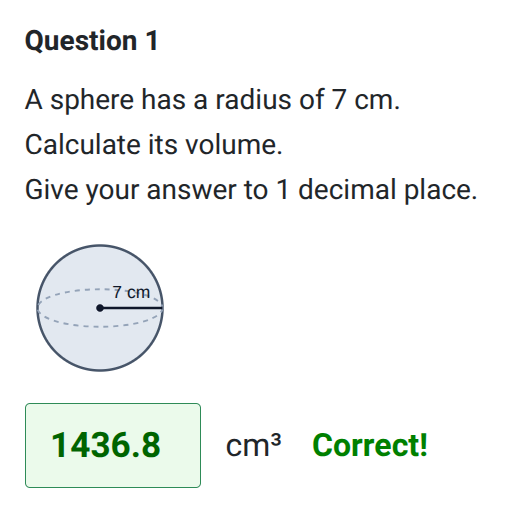
Work out the volume of the spheres and hemispheres, or use the volume to find the radius.
Topic guide
The formula for the volume of a sphere
To find the volume of a sphere, use the formula:
Volume = 4/3 πr³
where r is the radius of the sphere.
Radius and diameter
Make sure you have been given the radius (from the centre to the edge). If you are given the diameter (the full distance across), you must divide it by 2 to find the radius before using the formula.
Worked example: Sphere
Find the volume of a sphere with a radius of 5 cm. Give your answer to 1 decimal place.
- Identify the radius: r = 5
- Substitute into the formula: Volume = 4/3 × π × 5³
- Calculate 5³ = 125
- Volume = 4/3 × π × 125 = 500/3 π
- Calculate the decimal: 500 ÷ 3 × π ≈ 523.598...
- Round to 1 decimal place: 523.6 cm³
Volume of a hemisphere
A hemisphere is half of a sphere. To find its volume, simply halve the formula:
Volume = 2/3 πr³
Unlike surface area, you do not need to add anything for the flat circular base when finding the volume.
Exact answers in terms of π
Sometimes you will be asked to give your answer in terms of π. This means you multiply the numbers together but leave π as a symbol.
Example: Find the volume of a sphere with a radius of 3 cm. Give your answer in terms of π.
- Substitute: Volume = 4/3 × π × 3³
- Calculate 3³ = 27
- Multiply the numbers: 4/3 × 27 = 36
- Final answer: 36π cm³
Reverse problems (working backwards)
If you are given the volume and need to find the radius, you can set up an equation and solve it using a cube root.
Example: The volume of a sphere is 1500 cm³. Find its radius to 1 decimal place.
- Write the equation: 4/3 πr³ = 1500
- Multiply by 3 and divide by 4: πr³ = 1125
- Divide by π: r³ = 1125 / π (approx 358.09)
- Cube root: r = ∛358.09 ≈ 7.1 cm
Conservation of volume
In some applied problems, one shape is melted down and turned into another. The key is that the volume remains the same.
If a cuboid is melted to form a sphere, calculate the volume of the cuboid first. Then, set the volume of the sphere equal to that number and solve for the radius just like a normal reverse problem.
Common mistakes
- Using the surface area formula: Remember volume uses 4/3 πr³, not 4πr².
- Forgetting to cube the radius: Ensure you calculate r³ (r × r × r), not r² or 3r.
- Using the diameter: Always halve the diameter first to find the radius.
- Wrong units: Volume is 3D, so it uses cubic units (e.g. cm³, m³), not square units.
- Rounding too early: Do not round your numbers until the very final step of the calculation.