
Solving linear simultaneous equations
Simultaneous equations allow you to find the values of two different unknowns when you are given two equations that describe the same situation.
This worksheet focuses entirely on solving linear simultaneous equations algebraically using the elimination method. You will start by adding or subtracting equations to eliminate an unknown, before moving on to examples where you must multiply or rearrange equations first. Jump to the questions
Practise now
Worksheet preview and key skills
Worksheet preview
This interactive worksheet practises solving linear simultaneous equations using elimination. It begins with equations that can be added or subtracted immediately and progresses to problems requiring multiplication, rearrangement, and interpretation of worded contexts.
What you’ll practise
- Eliminating an unknown when coefficients already match.
- Multiplying one or both equations to create matching coefficients.
- Rearranging equations into the standard form before elimination.
- Applying simultaneous equations to worded real-world problems.
Use the interactive worksheet below, or read the Topic guide for the method and worked example.
Solving linear simultaneous equations
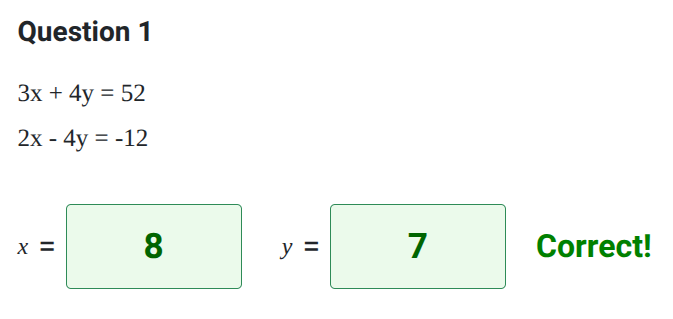
Solve each pair of simultaneous equations algebraically.
Topic guide
Simultaneous equations are two equations that share the same variables, usually x and y. To solve them, you must find the pair of values that makes both equations true at the same time.
The elimination method
The goal of the elimination method is to combine the two equations in a way that completely removes (eliminates) one of the variables, leaving you with a normal equation that has only one unknown.
You do this by either adding or subtracting the two equations:
- If the coefficients of a variable are the same (e.g. 3y and 3y), subtract the equations to eliminate that variable.
- If the coefficients of a variable are opposites (e.g. 3y and -3y), add the equations to eliminate that variable.
What if the coefficients don’t match?
If neither x nor y has matching or opposite coefficients, you must multiply one or both equations first. Multiply every term in the equation by a chosen number so that the coefficients of one variable become the same.
Worked example
Solve these simultaneous equations:
① 5x + 2y = 22
② 3x - 2y = 10
Step 1: Eliminate a variable
The y terms are +2y and -2y. Because they have different signs, we can eliminate y by adding the two equations together:
(5x + 3x) + (2y - 2y) = (22 + 10)
8x = 32
Step 2: Solve the one-variable equation
Divide by 8:
x = 4
Step 3: Substitute back to find the second variable
Now that we know x = 4, substitute this value back into either of the original equations. We will use equation ①:
5(4) + 2y = 22
20 + 2y = 22
Subtract 20 from both sides:
2y = 2
Divide by 2:
y = 1
Step 4: Check your answer
Finally, check both values in equation ② to make sure they work:
3(4) - 2(1) = 12 - 2 = 10
This is correct.
Common mistakes
- Sign errors when subtracting: Be very careful when subtracting a negative term. Subtracting a negative is the same as adding!
- Forgetting to multiply the constant: When multiplying an equation, remember to multiply the number on the right-hand side as well as the variables.
- Stopping halfway: You need to find values for both variables. Don't stop after finding the first one!