
Time and Timetables
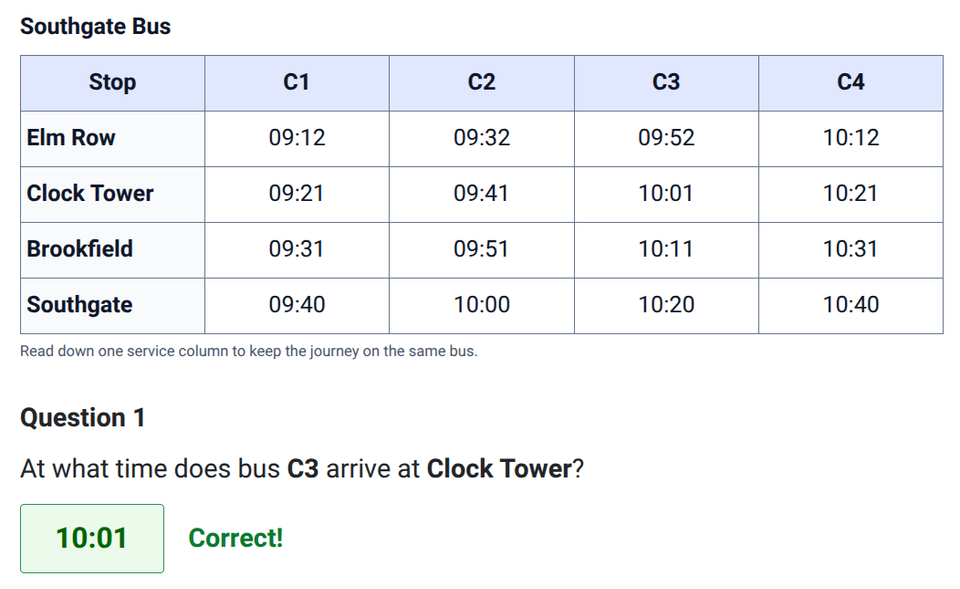
Read bus and train timetables with confidence, compare services and plan journeys that meet a deadline. This worksheet focuses on following one service column carefully, including services that skip stops and journeys with walking or connection times.
Practise now
Worksheet preview and key skills
Worksheet preview
Practise with bus and train timetables written in 24-hour time. Each question is worth one mark, with eight marks available.
The questions build from reading a single time to choosing viable services and planning connected journeys.
What you’ll practise
- Following one service column from stop to stop.
- Finding journey times, waits and the latest suitable departure.
- Comparing express and stopping services.
- Allowing for walks, changes and arrival deadlines.
Use the interactive worksheet below, or read the Topic guide for the method and worked example.
Topic guide
A timetable usually has stops in rows and services in columns. Once you choose a bus or train, follow that one column down the table. Moving into another column would mean changing to a different service.
Reading a service
- Find the row for the stop where the journey begins.
- Choose a service that leaves at a suitable time.
- Stay in the same column and read the time at the destination row.
- A — means that service does not stop there, so it cannot be used from or to that stop.
Durations and waiting times
For a journey time, subtract the departure time from the arrival time in the same service column. For a waiting time, find the first service at or after the time the traveller reaches the stop, then subtract the time they reached the stop. Remember that 1 hour = 60 minutes.
Worked example
| Stop | A1 | A2 express | A3 |
|---|---|---|---|
| Orchard | 09:10 | 09:18 | 09:30 |
| Library | 09:20 | — | 09:40 |
| Station | 09:35 | 09:38 | 09:55 |
A traveller reaches Library at 09:22. The A2 cannot be used because it does not stop at Library. The next suitable bus is A3 at 09:40, so the wait is 18 minutes. Staying in the A3 column shows an arrival at Station at 09:55.
Working back from a deadline
If someone must arrive by a stated time, first subtract any walk after the bus or train. Find all services that arrive by the new time, then choose the one with the latest departure. Finally, subtract any walk needed before the service leaves.
Useful checks
- Check both the stop row and service column before reading a time.
- For “by 15:00”, an arrival at exactly 15:00 is allowed.
- Allow the full stated connection time before choosing the next service.
- Do not use a service where the required stop is marked —.