
Angles in Parallel Lines
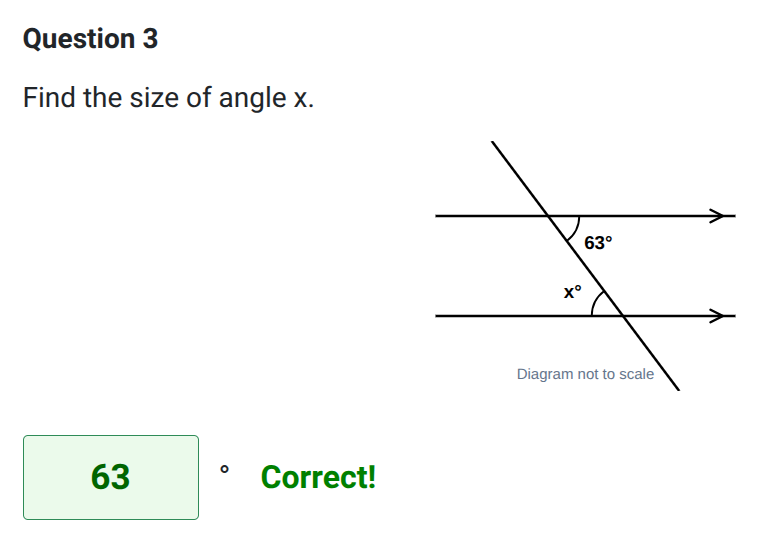
This worksheet provides practice on finding missing angles using the properties of parallel lines. You will start by identifying whether angles are corresponding, alternate or co-interior, and progress to using these facts alongside other angle properties to solve problems and form basic equations.
These angle facts are used throughout GCSE geometry, particularly in problems involving triangles, polygons and geometric reasoning. Jump to the questions
Practise now
Worksheet preview and key skills
Worksheet preview
This self-marking worksheet generates new sets of questions on angles in parallel lines. It begins with identifying relationships and moves through direct calculation to problem solving.
What you’ll practise
- Identifying corresponding, alternate and co-interior angles.
- Calculating missing angles using parallel line properties.
- Combining parallel line facts with other angle rules, such as vertically opposite angles and angles in a triangle.
- Forming and solving basic equations from parallel line diagrams.
Use the interactive worksheet below, or read the Topic guide for the method and worked example.
Angles in parallel lines
Use the rules of corresponding, alternate and co-interior angles to answer the questions.
Topic guide
When two straight lines never meet, they are parallel lines. A straight line that cuts across two or more parallel lines is called a transversal. This arrangement creates pairs of equal angles, as well as pairs of angles that add up to 180°.
Key angle relationships
- Corresponding angles are equal. These are angles in the same relative position at each intersection. They can sometimes be visualised making an 'F' shape.
- Alternate angles are equal. These are on opposite sides of the transversal and between the parallel lines. They can sometimes be visualised making a 'Z' shape.
- Co-interior angles add up to 180°. These are on the same side of the transversal and between the parallel lines. They can sometimes be visualised making a 'C' shape.
Useful supporting facts
When solving harder problems, you often need to combine parallel line rules with other basic angle facts:
- Vertically opposite angles are equal.
- Angles on a straight line add up to 180°.
- Angles in a triangle add up to 180°.
Worked example
You are given a diagram with two parallel lines and a transversal. One angle is given as 115°. You need to find angle x, which is alternate to the given angle, and angle y, which is vertically opposite to x.
Step 1: Since alternate angles are equal, x = 115°.
Step 2: Since vertically opposite angles are equal, y = 115°.
Important tips
- Check the diagrams: In an exam, diagrams are often "not drawn to scale". Do not measure angles with a protractor unless instructed; calculate them using the rules.
- Common mistake: Be careful not to confuse the rules. Remember that corresponding and alternate angles are equal, but co-interior angles sum to 180°.