
Speed, distance and time
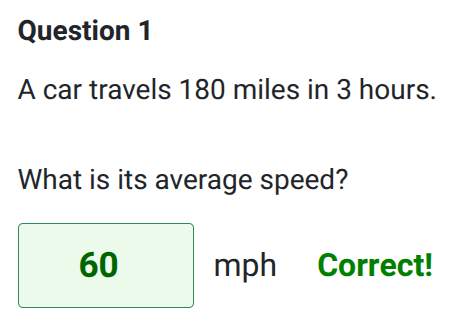
Practise using the speed, distance and time formula. This worksheet starts with straightforward whole-number calculations before moving on to converting hours and minutes, calculating arrival times and comparing multi-stage journeys. Jump to the questions
Practise now
Worksheet preview and key skills
Worksheet preview
This worksheet contains 18 interactive questions that test all the main skills needed for GCSE speed, distance and time calculations. It starts with simple substitution and progresses through to complex multi-stage journey reasoning.
The interactive inputs allow you to submit your answers in the correct units, such as hours and minutes, or as a 24-hour clock time.
What you’ll practise
- Calculating speed, distance or time from the other two variables.
- Converting between decimal hours and hours and minutes.
- Finding arrival times, including journeys that cross midnight.
- Calculating average speeds across multi-stage journeys.
Use the interactive worksheet below, or read the Topic guide for the method and worked example.
Speed, distance and time
Calculate the missing values. Pay careful attention to the units requested for your answer.
Topic guide
To solve speed, distance and time problems, you need to use these three relationships:
- Speed = Distance ÷ Time
- Distance = Speed × Time
- Time = Distance ÷ Speed
Important unit rules
Before you calculate anything, check that your units match. If a speed is in miles per hour, the distance must be in miles and the time must be in hours.
If you are given a time in minutes but the speed is in miles per hour, you must convert the time into hours first by dividing by 60.
Converting decimal hours to hours and minutes
When you calculate time, your calculator will often give a decimal answer, like 2.4 hours. This does not mean 2 hours and 40 minutes.
To convert 2.4 hours into hours and minutes:
- The whole number is the hours: 2 hours.
- Take the decimal part (0.4) and multiply it by 60 to find the minutes: 0.4 × 60 = 24 minutes.
So, 2.4 hours is exactly 2 hours and 24 minutes.
Worked example: Finding average speed
A train travels 135 miles in 2 hours and 15 minutes. What is its average speed?
First, convert the time entirely into hours. 15 minutes is a quarter of an hour (15 ÷ 60 = 0.25), so the time is 2.25 hours.
Now apply the formula:
Speed = Distance ÷ Time
Speed = 135 ÷ 2.25
Speed = 60 mph
Multi-stage journeys
To find the average speed over a journey with several stages, you must use the total distance and the total time.
Average speed = Total distance ÷ Total time
Do not just calculate the arithmetic mean of the speeds of each stage! A common mistake is to add two speeds together and divide by two. This will give the wrong answer unless the two stages happen to take exactly the same amount of time.