
Density, mass and volume
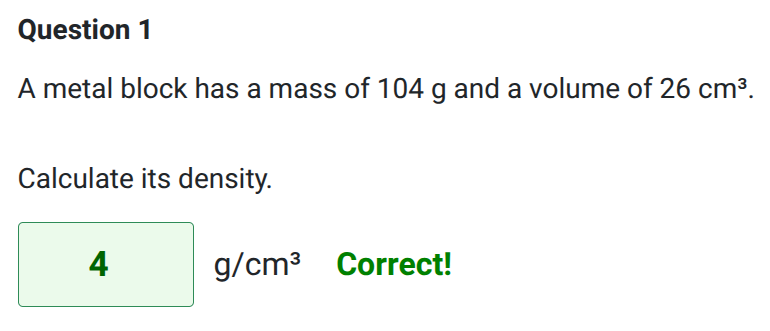
Density tells us how tightly packed the matter in an object is. An object with a high density feels heavy for its size, while an object with a low density feels light.
To calculate density, we use the formula:
Density = Mass ÷ Volume
You can also rearrange this formula to find the mass or the volume if you know the other two values:
- Mass = Density × Volume
- Volume = Mass ÷ Density
Common units for density include g/cm³ (grams per cubic centimetre) and kg/m³ (kilograms per cubic metre). For liquids, you might see g/ml, and it is useful to remember that 1 cm³ is exactly the same as 1 ml.
Before you calculate anything, always check that your units match. If your density is given in g/cm³ but your mass is in kilograms, you will need to convert the mass to grams first.
In harder multi-step problems, you might need to calculate the volume of a 3D shape (like a cuboid) from its dimensions before you can use the density formula, or you might need to work out the combined density of two mixed materials. Jump to the questions
Practise now
Worksheet preview and key skills
Worksheet preview
The interactive worksheet begins with straightforward substitution to find density, mass or volume from the other two known values. It then progresses through important unit conversions, such as working with kilograms and cubic metres, or using the equivalence between cm³ and ml for liquids.
Later questions involve calculating the volume of a cuboid from its dimensions before applying the density formula, determining whether an object will float based on its calculated density, and solving multi-stage problems involving mixtures of two different materials.
What you’ll practise
- Using the formula density = mass ÷ volume.
- Rearranging the formula to find mass or volume.
- Ensuring units match before calculating (e.g. converting kg to g).
- Using the fact that 1 cm³ = 1 ml.
- Calculating volume from dimensions to solve 3D density problems.
- Comparing the densities of different materials.
Use the interactive worksheet below, or read the Topic guide for the method and worked example.
Density, mass and volume
Calculate the missing values. Pay careful attention to the units requested for your answer.
Topic guide
Density is a measure of how much mass is contained within a given volume. A material with a high density, like lead, feels very heavy for its size. A material with a low density, like foam, feels very light.
The formula
The relationship between density, mass, and volume is given by the formula:
Density = Mass ÷ Volume
Depending on what information you are given, you can rearrange this to find the other values:
- Mass = Density × Volume
- Volume = Mass ÷ Density
Units and conversions
The units for density depend on the units used for mass and volume. Common examples include:
- If mass is in grams (g) and volume is in cubic centimetres (cm³), density is in g/cm³.
- If mass is in kilograms (kg) and volume is in cubic metres (m³), density is in kg/m³.
- For liquids, density is often measured in g/ml.
Important: 1 cubic centimetre (cm³) is exactly equal to 1 millilitre (ml). Therefore, a density of 1 g/cm³ is the same as 1 g/ml.
Always ensure your units match before calculating. If a question gives you a density in g/cm³ but a mass in kilograms, you must convert the mass to grams (multiply by 1000) before you divide.
Worked example 1: Finding density from dimensions
A solid wooden cuboid measures 10 cm by 5 cm by 4 cm. Its mass is 150 g. Calculate the density of the wood.
- First, calculate the volume of the cuboid.
Volume = length × width × height = 10 × 5 × 4 = 200 cm³. - Now, use the density formula.
Density = Mass ÷ Volume
Density = 150 ÷ 200 = 0.75 g/cm³.
Worked example 2: Mixing materials
Liquid A has a density of 1.2 g/ml and a volume of 50 ml. It is mixed with 150 ml of Liquid B which has a density of 0.8 g/ml. Calculate the density of the final mixture.
To find the combined density, you need the total mass and the total volume.
- Find the mass of Liquid A:
Mass = Density × Volume = 1.2 × 50 = 60 g. - Find the mass of Liquid B:
Mass = 0.8 × 150 = 120 g. - Find the total mass and total volume:
Total mass = 60 + 120 = 180 g.
Total volume = 50 + 150 = 200 ml. - Calculate the new combined density:
Combined density = Total mass ÷ Total volume
Density = 180 ÷ 200 = 0.9 g/ml.