
Writing Ratios as Fractions
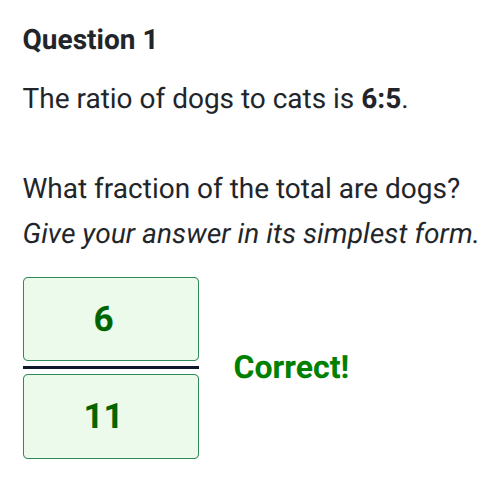
Ratios describe how parts of a total relate to each other. Understanding how to turn these ratio parts into fractions of a whole is an essential mathematical skill.
This worksheet practises converting between two-part or three-part ratios and fractions, finding the fraction for a combination of parts, and reversing the process to write fractions as ratios. Jump to the questions
Practise now
Worksheet preview and key skills
Worksheet preview
This worksheet provides targeted practice on converting between ratios and fractions. It begins with simple two-part ratios and progresses through to three-part ratios and reverse conversions.
The final questions challenge you to apply your reasoning to multi-stage problems involving subgroups.
What you’ll practise
- Writing one part of a two-part ratio as a fraction of the total.
- Writing one part of a three-part ratio as a fraction of the total.
- Finding the fraction represented by combined parts (e.g. “not blue”).
- Simplifying fractions derived from ratios where necessary.
- Reversing the process: using a fraction of a total to write a two-part ratio.
- Using two given fractions to construct a three-part ratio in simplest form.
- Applying these skills to harder contextual problems.
Use the interactive worksheet below, or read the Topic guide for the method and worked example.
Writing ratios as fractions
Convert between ratios and fractions. Give your answer in its simplest form when asked.
Topic guide
A ratio shows how a total is split into parts. By finding the total number of parts, you can write any part of the ratio as a fraction of the whole.
Converting a two-part ratio to a fraction
If a ratio has two parts, the denominator of the fraction is the sum of those parts.
For example, if the ratio of boys to girls is 2:3:
- The number of parts for boys is 2.
- The number of parts for girls is 3.
- The total number of parts is 2 + 3 = 5.
Therefore, boys make up 2/5 of the total, and girls make up 3/5 of the total.
Converting a three-part ratio to a fraction
The same logic applies when a ratio has three or more parts. Add all the parts together to find the total.
For example, if red, blue and green counters are in the ratio 4:1:3:
- Total parts = 4 + 1 + 3 = 8.
- Red counters are 4/8 (which simplifies to 1/2) of the total.
- Blue counters are 1/8 of the total.
- Green counters are 3/8 of the total.
Combining parts to find a fraction
Sometimes you need to find the fraction for a combination of groups, such as "not red". Simply add the relevant parts together to find your numerator.
Using the 4:1:3 ratio above, the counters that are "not red" are the blue and green counters.
- Blue parts + green parts = 1 + 3 = 4 parts.
- The fraction of counters that are not red is 4/8, which simplifies to 1/2.
Reversing a fraction into a ratio
If you know the fraction for one part, you can work backwards to find the ratio.
If 3/7 of the students walk to school, that means 3 out of every 7 parts walk. The remaining students do not walk.
- Total parts = 7.
- Walking parts = 3.
- Not walking parts = 7 − 3 = 4.
The ratio of those who walk to those who do not walk is 3:4.
Worked example: Finding a fraction from nested ratios
Sometimes a group is split into a ratio, and one of those subgroups is split again.
Example: In a sports club, the ratio of adults to children is 3:2. Among the children, the ratio of boys to girls is 1:4. What fraction of everyone in the club are girls?
- The fraction of people who are children is 2/5 (since 3 + 2 = 5 total parts).
- The fraction of children who are girls is 4/5 (since 1 + 4 = 5 total child parts).
- To find the fraction of everyone who are girls, multiply these fractions together:
2/5 × 4/5 = 8/25.
So, 8/25 of the people in the club are girls.
Common mistakes to avoid
- Using the wrong denominator: The most common mistake is treating a ratio of 2:3 as meaning 2/3 of the total. Remember that the total parts are 2 + 3 = 5, so the fraction is 2/5.
- Taking the wrong numerator: Ensure you are selecting the part of the ratio that matches the group asked for in the question. Order matters!
- Forgetting a part: In a three-part ratio, make sure you add all three numbers to find the total denominator.
- Reversing the ratio: When turning a fraction back into a ratio, check that the parts are written in the correct order requested.
- Failing to simplify: Always check if your final fraction or ratio can be simplified by dividing both numbers by a common factor.