
Writing Ratios as Linear Functions
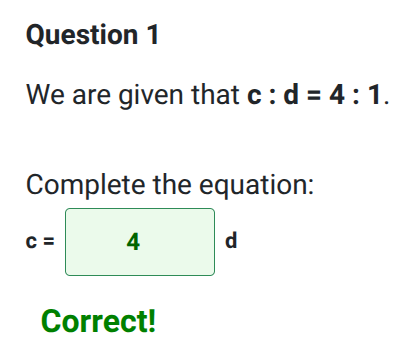
A fixed ratio links two quantities by a constant multiplier. Because this multiplier never changes, we can write the relationship as a simple linear equation.
This worksheet practises writing ratios as equations, finding missing values using those equations, and interpreting a simple straight-line graph. Jump to the questions
Practise now
Worksheet preview and key skills
Worksheet preview
This interactive worksheet focuses on translating between fixed ratios and linear functions. You will start by writing simple equations from integer ratios, before moving on to fractional multipliers.
The later questions ask you to reverse an equation back into a ratio, complete a value table, and interpret a linear graph through the origin.
What you’ll practise
- writing one variable in terms of another from a ratio;
- handling fractional multipliers;
- reversing a linear relationship to recover a ratio;
- using the relationship in a table and in context;
- interpreting a simple line through the origin.
Use the interactive worksheet below, or read the Topic guide for the method and worked example.
Writing ratios as linear functions
Write ratios as equations and find missing values. Give fractions in their simplest form when asked.
Topic guide
What a ratio tells you about two variables
A ratio compares the sizes of two quantities. If two quantities are in a fixed ratio, multiplying one by a constant value will always give you the other.
Because this multiplier is constant, the relationship between the two variables is linear.
Writing the first variable in terms of the second
If we know the ratio a : b = m : n, we can write an equation for a in terms of b.
To get from the right side of the ratio to the left side, we multiply by the fraction m/n.
Therefore: a = (m/n)b.
Writing the second variable in terms of the first
If we want to write b in terms of a instead, we reverse the direction.
To get from the left side of the ratio to the right side, we multiply by the fraction n/m.
Therefore: b = (n/m)a.
Worked example with a fractional multiplier
Question: Red and blue counters are in the ratio R : B = 5 : 2. Write an equation for B in terms of R.
Answer: We want to go from R (5 parts) to B (2 parts). The multiplier is 2/5.
The equation is B = (2/5)R.
Going backwards from an equation to a ratio
If you are given a linear relationship, you can turn it back into a ratio by reading the coefficient as a fraction.
For example, if y = (3/4)x, then the multiplier from x to y is 3/4. This means for every 4 parts of x, there are 3 parts of y.
The ratio is x : y = 4 : 3.
Using the relationship to complete values
Once you have a linear equation, you can substitute a known value into it to find the other value.
If y = (5/2)x and we know x = 6, then y = (5/2) × 6 = 15.
If we know y = 20 instead, we can work backwards: 20 = (5/2)x, so x = 20 × (2/5) = 8.
Why the graph is a straight line through the origin
If two variables are in a fixed ratio, their graph will always be a straight line that passes exactly through the origin (0, 0). This is because if one quantity is zero, the other must also be zero to keep the ratio fixed.
If a graph passes through the origin and a point like (4, 7), the ratio of x to y is 4 : 7, and the relationship is y = (7/4)x.
Common mistakes
- Using the coefficient upside down: Always check which direction you are moving. From a:b = 3:5, we get a = (3/5)b, not a = (5/3)b.
- Ignoring which variable is the subject: Read the question carefully to see which variable should be on its own on the left.
- Confusing equations and values: If a:b = 3:5, it does not mean a = 3/5. It means a = (3/5)b.
- Adding ratio parts incorrectly: Do not add ratio parts (like using 8 if the ratio is 3:5) when comparing one variable directly with another variable.
- Reversing the ratio: When converting y = (3/5)x back to a ratio, it is x:y = 5:3, not 3:5. The fraction tells you the multiplier from x to y.