
Changing the Subject of a Formula
Changing the subject of a formula means rearranging it so a different letter is on its own on one side of the equals sign. It is exactly the same process as solving an equation, except you are working with letters instead of numbers.
This worksheet provides practice rearranging formulas using inverse operations. You will start with simple one-step rearrangements before moving on to formulas involving multiple terms, brackets, fractions, powers and square roots. Jump to the questions
Practise now
Worksheet preview and key skills
Worksheet preview
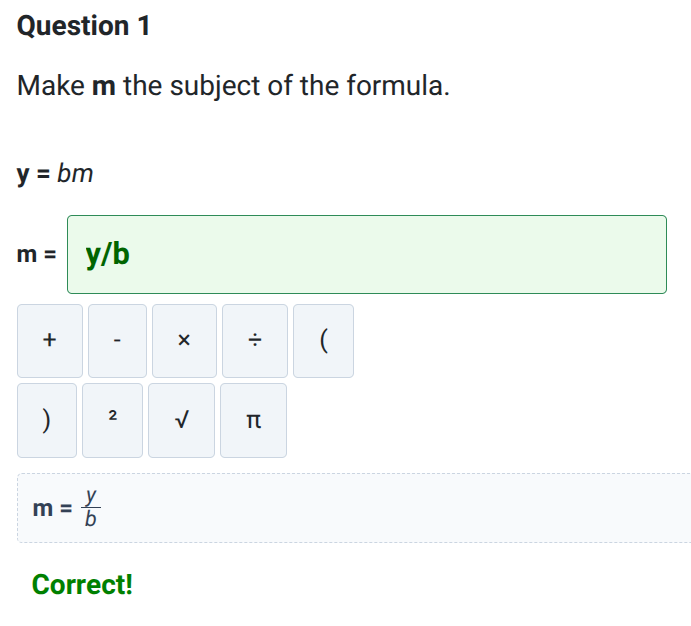
This interactive worksheet requires you to type an algebraic expression into the answer box.
A small keypad is provided to help you quickly insert symbols like brackets, fractions and powers on a touchscreen, or you can use your normal keyboard.
What you’ll practise
- Using inverse operations to rearrange formulas.
- Isolating a specified subject variable.
- Handling formulas involving brackets and fractions.
- Rearranging formulas involving squares and square roots.
Use the interactive worksheet below, or read the Topic guide for the method and worked example.
Changing the subject of a formula
Rearrange each formula to make the specified letter the subject. Use the keypad or your keyboard to enter the algebraic expression.
Topic guide
The subject of a formula is the variable (letter) that is isolated on its own on one side of the equals sign. For example, in the formula A = bh, the subject is A.
Changing the subject means rearranging the formula to get a different letter on its own. You do this by performing inverse operations to both sides of the formula, maintaining balance at every step, exactly like solving an equation.
Sensible order of operations
Look at what has been done to the subject and undo those operations in reverse order, working from the outside in.
The correct order depends entirely on the structure of the formula.
Worked Example
Make x the subject of the formula y = 3x - 5.
Step 1: Undo the subtraction.
The 3x has 5 subtracted from it. The inverse of subtracting 5 is adding 5 to both sides.
y + 5 = 3x
Step 2: Undo the multiplication.
The x is multiplied by 3. The inverse of multiplying by 3 is dividing the whole of the other side by 3.
(y + 5) / 3 = x
We can write the subject on the left-hand side to finish:
x = (y + 5) / 3
Fractions and Denominators
If the letter you want is trapped inside a fraction numerator, multiply both sides by the denominator first.
If the letter you want is in the denominator, multiply both sides by it to get it out of the fraction, and then divide to isolate it.
Common Mistakes
- Moving terms magically: Do not just "move a term to the other side and change the sign". Always think about what inverse operation you are applying to both sides.
- Partial division: If you divide by 2, you must divide the entire other side by 2. For example, if 2m = p + q, then m = (p + q) / 2, not p/2 + q.
- Leaving the subject on both sides: The requested subject cannot remain anywhere in the algebraic expression you write.
- Dropping squares: If a formula contains r² and you want r, remember to apply a square root at the very end. r = √(something).