
Changing the Subject of a Formula — Harder
This harder worksheet builds on standard rearranging by introducing more complex algebraic structures.
You will need to expand brackets, deal with fractions and rational expressions, and factorise when the subject appears in more than one term. These are key skills for the higher tier. Jump to the questions
Practise now
What does this worksheet cover?
Changing the Subject of a Formula — Harder
This worksheet provides 8 interactive questions designed to test advanced formula rearrangement skills required for the higher tier.
- Rearranging formulae with fractional coefficients.
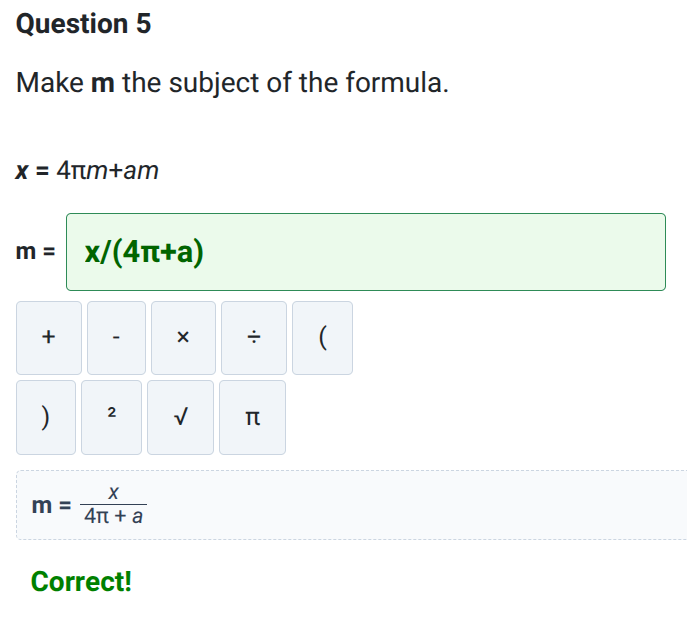
- Extracting the subject when it is part of a complex product involving π.
- Isolating a squared subject and specifying the correct positive domain.
- Expanding brackets and collecting terms to isolate a subject on both sides of an equation.
- Factorising the required subject out of multiple algebraic terms.
- Rearranging rational expressions, including dealing with the subject in a denominator.
- Applying these skills to a standard applied context, such as isolating a term in the cosine rule.
Changing the subject of a formula — Harder
Rearrange each formula to make the specified letter the subject. Use the keypad or your keyboard to enter the algebraic expression.
Topic guide
When the Subject Appears More Than Once
If the variable you want to make the subject appears in more than one term, you must collect all those terms on one side of the equation and factorise.
Example: Make m the subject of y = 3mt − a²m.
- The subject m is in both terms on the right-hand side.
- Factorise m out of the expression: y = m(3t − a²).
- Divide both sides by the bracketed term: m = y / (3t − a²).
Subject on Both Sides
Often, the equation will have terms containing the subject on both sides, and there may be brackets involved.
Example: Make x the subject of 5(x + y) = 4(x − 3y).
- Expand all brackets first: 5x + 5y = 4x − 12y.
- Collect the x terms on one side (e.g. subtract 4x): x + 5y = −12y.
- Collect the other terms on the opposite side (subtract 5y): x = −17y.
Rearranging Fractions
When the formula contains fractions, your first goal is usually to multiply through by the denominator to remove the fraction entirely.
Example: Make c the subject of w = ac / (a − c).
- Multiply both sides by (a − c) to eliminate the denominator: w(a − c) = ac.
- Expand the brackets: wa − wc = ac.
- Collect the terms containing c on one side (add wc to both sides): wa = ac + wc.
- Factorise out c: wa = c(a + w).
- Divide to isolate c: c = wa / (a + w).
Powers and Square Roots
If the requested subject is squared, you will usually need to isolate the squared term first, then apply a square root as the final step. Take care to ensure the square root encompasses the entire expression.
Example: Make r the subject of V = πr²h. Assume r is positive.
- Isolate r² by dividing both sides by πh: r² = V / (πh).
- Take the square root of both sides. Since r is positive, you only need the positive root: r = √(V / (πh)).
Common Mistakes
- Failing to expand every term: When expanding 3(m + 4), ensure you multiply both terms: 3m + 12, not 3m + 4.
- Moving only one occurrence: If the subject appears multiple times, you cannot simply leave one on the other side of the equation. You must collect all terms and factorise.
- Sign errors: Be very careful when subtracting a term to collect it on the other side. Remember that subtracting a negative is equivalent to adding a positive.
- Confusing uppercase and lowercase: In formulas like the cosine rule (a² = b² + c² − 2bc cos A), the uppercase A (an angle) and lowercase a (a side) represent entirely different quantities. Do not swap them or combine them.