
Similar shapes
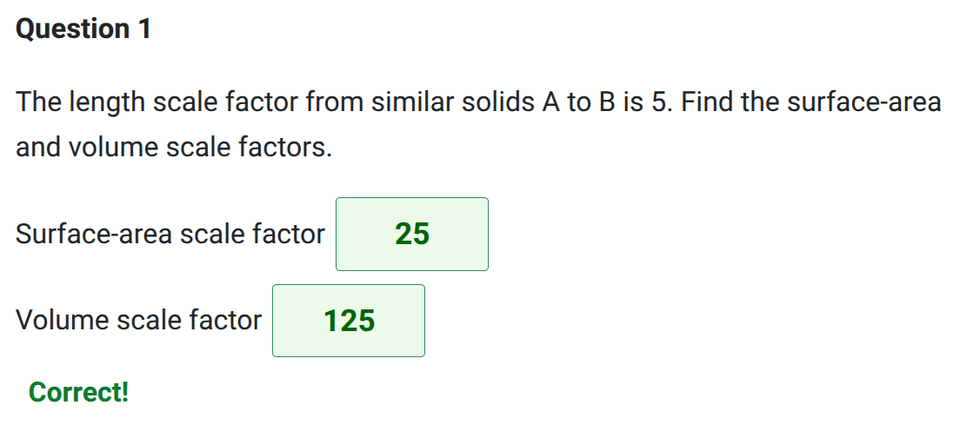
Practise area, surface area and volume scale factors for similar shapes at GCSE Higher level. Corresponding lengths scale by k, areas and surface areas by k², and volumes by k³.
Work forwards from lengths or backwards from areas and volumes: square-root an area factor or cube-root a volume factor to recover k. Keep the direction consistent, from A to B or from B to A, throughout each calculation. Jump to the questions
Practise now
Worksheet preview and key skills
Worksheet preview
Eight questions, worth one mark each, build from area and volume scale factors to mixed similar-solid problems. A question with several entries earns its mark when all entries are correct.
Start with k² and k³, then find a missing area, recover a length from areas, find a volume and recover a length from volumes. Finish by finding a volume from surface areas, converting ratios, and finding a surface area from a volume ratio.
What you’ll practise
- Direct and reverse area and volume scaling, including enlargements and reductions.
- Square roots and cube roots to recover the length scale factor.
- Surface-area-to-volume problems and length, surface-area and volume ratio conversion.
Use the interactive worksheet below, or read the Topic guide for the method and worked examples.
Similar shapes
Answer each question and press Check answer. Give exact values and ratios in simplest integer form; diagrams are not drawn to scale.
Topic guide
Choose the right scale factor
Similar shapes have corresponding lengths in a constant ratio. If the length scale factor from A to B is k, every length is multiplied by k, every area or surface area by k², and every volume by k³. You do not need an area or volume formula when that quantity is already given.
Use corresponding lengths to find k = length on B ÷ length on A. For a reduction, k is less than 1. Keep A-to-B or B-to-A consistent throughout the question; diagrams need not be drawn exactly to scale.
Worked area example
Two similar shapes have corresponding lengths 8 cm and 12 cm. The smaller shape has area 28 cm². From smaller to larger, k = 12 ÷ 8 = 3/2. The area factor is (3/2)² = 9/4, so the larger area is 28 × 9/4 = 63 cm².
Work backwards from an area or volume
If areas or surface areas are given, first find their factor, then take its square root to recover k. If volumes are given, take the cube root of the volume factor instead.
For example, similar solids A and B have volumes 135 cm³ and 40 cm³. A corresponding length on A is 9 cm. From A to B, the volume factor is 40/135 = 8/27. So k = ∛(8/27) = 2/3 and the length on B is 9 × 2/3 = 6 cm.
Move between surface area and volume
If the surface-area ratio A:B is 16:25, square-root both terms to get the length ratio 4:5. Cube those terms to get the volume ratio 64:125. If A has volume 192 cm³, B has volume 192 × 125/64 = 375 cm³. In the other direction, cube-root the volume ratio and then square the length ratio to find the surface-area ratio.
Common mistakes
- Multiplying area by k instead of k².
- Multiplying volume by k² instead of k³.
- Square-rooting a volume ratio or cube-rooting an area ratio.
- Reversing the scale factor part-way through a calculation.
- Confusing length in cm, area in cm² and volume in cm³.
- Measuring a diagram or assuming it is drawn exactly to scale.
Before calculating, identify what is known, what is wanted and the direction of scaling.